When she was 4, Areeb Zuaiter traveled to Gaza and saw the sea for the first time. That moment – the magic of the sea and the smile on her Palestinian mother’s face – had a lasting impact. Many years later when she is an award-winning filmmaker, she sees a video of a team of young Palestinian men doing parkour* on Gaza’s sandy shores, her nostalgia resurfaces. The joy of the young athletes engaged in daredevil derring-do stands in stark contrast to the distant echoes of artillery explosions. Longing to reconnect with her past, Zuaiter contacts the parkour team and befriends Ahmed. Together, they navigate what is left of Gaza, exploring a cemetery, a run-down shopping center, and the remains of an airport where the young men train.
As their relationship deepens, Ahmed reveals the harsh realities of life in Gaza, and Areeb’s initial curiosity transform into a profound awareness of the struggles he faces. Areeb grapples with feelings of guilt and conflict as she empathizes with Ahmedʼs desire to escape the confines of his homeland, understanding the emotional void such a departure would entail.
Framed as a narrated letter from Zuaiter to her mother, YALLA PARKOUR tells of the director’s quest to reclaim memories but also explore identity, belonging and the haunting legacy of a home left behind: A powerful poetic telling ever there was one.
*Parkour

Also called art du déplacement or free running in some contexts is a training method where practitioners — known as traceurs (men) or traceuses (women) — move through spaces using running, jumping, climbing, vaulting, and balancing to get from point A to point B as quickly and efficiently as possible. In YALLA PARKOUR, catapulted jumping and vaulting and balancing takes place at the top of buildings several stories high. The young men and youth who catapult themselves at many times seemed to be staring face-to-face with death, risking life and limb.
Areeb Zuaiter is a multinational filmmaker based in Washington, D.C. Her work focuses on art, identity, and social issues. Zuaiter has won multiple international awards. Her debut short, Stained, won the Jury Award at Beirutʼs European International Film Festival.
Her documentary, Colors of Resistance, was nominated for Sonyʼs Outstanding Thesis Award and won multiple awards at the Colorado Activism Film Festival and the Spotlight Documentary Film Awards. Zuaiter had previously worked at the Associated Press, and served a Goldman Sachs Film and Video Fellow at the Smithsonianʼs National Museum of American History. Zuaiter lead the Regional Training Department at the Royal Film Commission – Jordan, and taught at several universities in Washington, D.C. In addition to working on her films, Zuaiter heads the programming department at the Amman International Film Festival (AIFF).
This date: Gaza is in a state of profound humanitarian collapse despite what is supposed to be a ceasefire declared in October. Roughly 90 percent of the population has been displaced, large swaths of its urban landscape lie in ruins, and famine conditions persist across much of the territory. Hospitals and basic infrastructure — water, sanitation, electricity — remain critically degraded, and widespread malnutrition continues, especially among children and the elderly. Though some symbolic acts of normal life have reappeared, such as recent mass weddings, the territory is still marked by ongoing life-destroying demolitions, sporadic military operations bloody to the core, and a fragile, uneasy calm that can rip into a tempest of blood and torment in the blink of an eye.
Director Areeb Quaiter’s Q&A at Scandinavia House – The Nordic Center in America, Manhattan, December 1
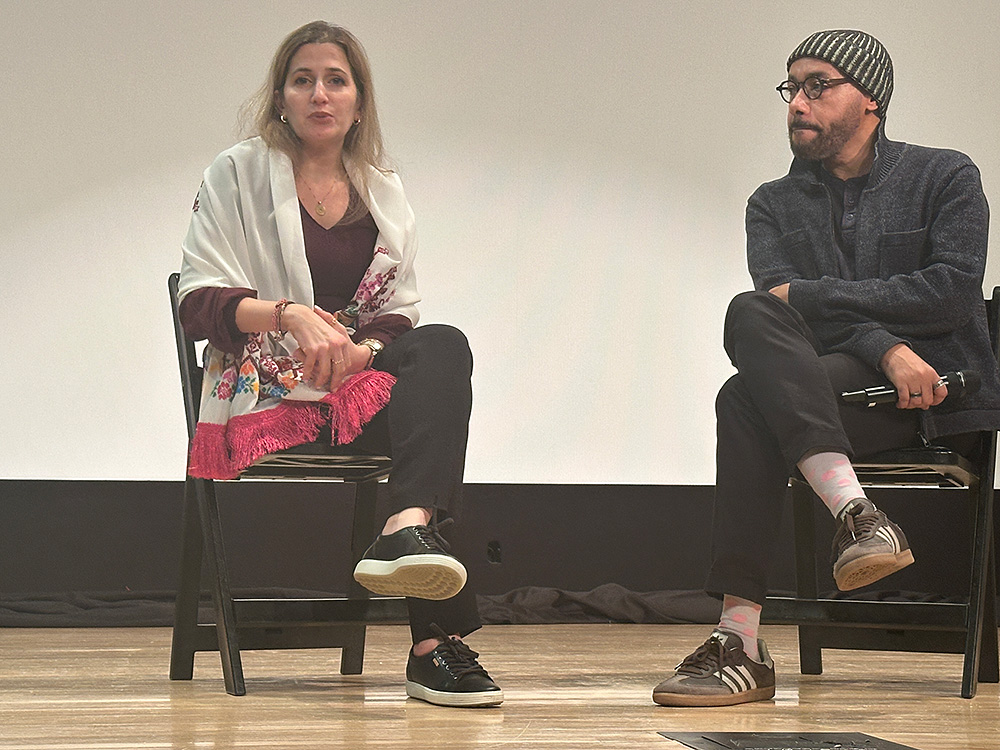
Director Areeb Zuaiter, Moderator Murtada Elfadl.
Edited for style, context and readability. The Audience Q&A with YALLA PARKOUR Director Areeb Zuaiter took place at the Scandinavia House – The Nordic Center in America on the Upper East Side of Manhattan. It was moderated by Murtada Elfadi, a Variety magazine critic and a curator DOC NYC. Considering it was bitter cold in Manhattan, there was a sizable crowd on a chilling cold evening in the Big Apple The audience seemed in awe and enthralled after the movie screened but there weren’t a lot questions: The audio system was not working well.
Nevertheless, one of the early introductory questions of Director Areeb Zuaiter by Moderator Director Areeb Zuaiter was an inquiry about the parkour youth whose derring-do parkour in the film was riveting and compelling. This reviewer sometimes worried that his gasps during the screening were way to audible.
Director Areeb Zuaiter said “as we can imagine, they’re not doing really well. During the past two years when everything started (Israel and Hamas violence), they fled their house.”
“Eventually their house got bombed and only one room stayed standing still. The mom got really tired of staying at other people’s houses and she asked her family to go back to that one room, so they’re there now. They have one piece of cloth for privacy and shelter and their daughter is living on the roof. She has two babies that she got during these past two, three years. It’s a really devastating condition that they’re living under.
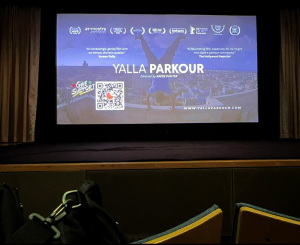
We launched a ShareDoc campaign – www.share-doc.org/d/125001/yalla-parkour – to help them. If you saw the QR code at the beginning, or you can go to ShareDoc and connect to the Yalla Parkour, you’ll see the campaign if you’d like to contribute.
Moderator Murtada Elfadl: Ahmed is in Sweden.
Director Areeb Zuaiter: Ahmed is in Stockholm. The last time he went is when you saw him in the film. Actually, initially my goal was to wait for him until he goes back to meet his family in Sweden, but then everything changed after the war.
Moderator Murtada Elfadl: So maybe we can go back to the start of your relationship with Ahmed. And how, as we saw in the film, you watched his videos and that was the start of this relationship. Tell us about finding him and this growing relationship between you two and how he became your eyes to Palestine.
Director Areeb Zuaiter: Yes, I always say this film was born out of war. It came out during … my relationship with Ahmed started in 2014. It was a 50-plus-day (artillery) offensive happening on Gaza. And I was at a devastated stage surfing the news always on YouTube. I just have my daughter whom you see in the film and I was thinking what kind of a world am I bringing her into?
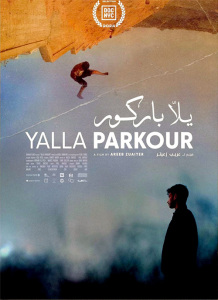
And then I see this clip that you saw of young men doing acrobatic moves against the colossal bombing in the background. And this guy smiling took me back to the summer trips that my mom used to take us to. We would go to Nablus, my hometown.
We would go there in the summer and there will be really harsh conditions of Intifada, stuff like that, and people will be laughing in the terraces. That smile just took me back there and I thought I need to do a connection with the team. I found them on Facebook, so I texted them on messenger and Ahmed was the guy who picked up.
I asked him where is [inaudible 00:04:16], the guy who smiled at me and he told me that he already left to Sweden. And we started talking since then.
There were ups and downs in relationships, especially that it was virtual. I never met Ahmed in person until he made it to Sweden, which really breaks my heart when I think of it. We as Palestinians, we don’t get to meet each other in our hometown, we only get to meet … outside of Palestine.
But then when we met in person, our relationship really fortified and we became friends. That’s when he really opened up. Actually, the film, I would say the over arching theme of the film is longing. It’s the place I longed for.
Moderator Murtada Elfadl: Makes sense. I was struck by what you said about we Palestinians … which reminds me of the … what you say in the film, [that they have … – to me that’s what the film is about. Maybe you can tell us a little bit more.
Director Areeb Zuaiter: Yes, I mean, I’ve seen that. Like I said, I’ve seen that in my mom, for example. She’s someone whom I would really see come back to the, what she would call (home) … I’ve seen her enduring and … a majority of her life is outside of the place she loves, but still ,she made the best out of it.
When I think of Ahmed’s parents, or his mom specifically, like I said in the beginning, she’s now somebody who’s trying to overcome this really drastic situation by living in the place she loves, which had been home. I think this reputation comes from these details and these situations that we see ourselves forced to endure and live.
Moderator Murtada Elfadl: Has the film been shown in Palestine?
Director Areeb Zuaiter: Yes, only last week. Only last week we … I mean, we were invited to screen it in Gaza before, and I was against that just because I wouldn’t live with the fact that something would happen. A group of people were gathering to watch a film and then something happens.
I mean, I would love for a safe circumstance and really a nice conditions for the film to be shown there and I’m working on that currently with the group who helped me film. But our first screening was in Jerusalem through Al Ma’mal Foundation. It happened during Thanksgiving day, on Thursday. Unfortunately I can’t make it to Jerusalem because of my identity, so we ended up doing a Zoom discussion with the audience and it was really … It was a dream come true.
Moderator Murtada Elfadl: I mean, I saw the pictures on Instagram. It seemed like it was a wonderful screening.
Director Areeb Zuaiter: Yes.
Moderator Murtada Elfadl: We had the film at DOC NYC last year. You won the Grand Jury Prize. And since then, the film has traveled to Berlin to other festivals. It won other awards in Hong Kong and whatever. Tell us a little bit about the reaction, especially from Palestinians who are all over the world.
Director Areeb Zuaiter: I mean, I would always be … how do you call it … anxious whenever Palestinians are in the audience, because I’m not sure how they would receive my emotions towards …
Specifically by my husband who lived in Palestine most of his childhood and adolescence and everything, he describes me as somebody who’s nostalgic. I’m longing for a place I never lived in, and I never lived the harsh realities of. And sometimes I think maybe I’m too simplistic in my emotions to that place. But to be honest, I feel that these emotions are mainly shared by all Palestinians who have been living in the diaspora. There is this bond that ties us together, which is we can’t return, but there is part of us that’s still living there.
Moderator Murtada Elfadl: Amen. I mean, these emotions you talked about is what made you make this beautiful film, so maybe that instinct is correct.
You are in the film, in the film, and we hear your voice. And that’s a very delicate line to cross making us interested in your story, but also in Ahmed and also this all encompassing story about longing to go back to Palestine, which is something you share with all Palestinians. Can you tell us about the post-production and how you brought all these elements together to cohere so well?

Director Areeb Zuaiter: Yeah, this is … I have to be honest, I never intended for myself to be in the film. My objective was simply following the trajectory of Ahmed’s story. I wanted him to go … Once I knew that he’s fleeing Gaza and he succeeded in going out, I was determined to follow his story. Because at the beginning I was following the group as a whole, and then that’s when I felt his story becoming similar, is becoming similar to mine, and I was mostly interested in his own story from that moment on.
But then, okay, what I was envisioning for him to happen happened. He went back to Gaza, met his mom, and went back to Sweden, and that was where the film ends for me.
We were in the editing room and October 7, as it happens. We start losing one crew member after the other, and we lose also one of the team players. You see him in the film, a parkour player … he was trying to help, to help people from under the rubble when another shelling takes place, and he gets martyred with his brother. We thought we would be perceived as so insensitive if we don’t address what’s going on right now. And I kept thinking, how can I do that when I just finished filming?
That’s when my mom’s image would always pop into my head, because she’s the one who would be so emotional when something bad happens in Palestine, and I decided to make the film more of a letter to her.
– 30 –

the WORD Editor, Reviewer Gregg W. Morris