the WORD @ 2026 Sundance Film Fest
Part 1, Introduction

January 5, 2026

🎥 Basic Details

Dates: In-person festival: January 22 – February 1, 2026 in Park City and Salt Lake City, Utah. Online/at-home program: January 29 – February 1, 2026. Host & Organizer: Sundance Institute — nonprofit organization dedicated to discovering and supporting independent storytellers. This will be the last Sundance Film Festival held in Utah before the festival relocates to Boulder, Colorado in 2027.

Official site: festival.sundance.org (full schedules, ticketing details, and film info).

Selected Projects

The Festival unveiled 97 projects — including 90 feature films and 7 episodic projects — representing global voices and innovative cinema. Short Films: A slate of 54 short films has been announced, drawn from a record number of submissions. Highlighted Films: Films scheduled to premiere include Mum, I’m Alien Pregnant (Midnight section) and the documentary Cookie Queens, among many others.

Lineup Variety: The festival features a mix of feature films, documentaries, episodic storytelling, and experimental works, including world premieres and works by both emerging and established artists.

Premieres & Screenings:

  • Official film premieres take place Jan 22 – Jan 27, with continued showings throughout the festival.

Park City Legacy Program:

A special program celebrating the festival’s history with archival screenings, artist talks, and community events.

Tribute Event

A “Celebrating Sundance Institute: A Tribute to Founder Robert Redford” fundraiser event will honor cinema and storytelling, with awards for distinguished contributors. (sundance.org – sundance.org)


Awards Ceremony


The jury and audience awards will be presented on January 30, 2026 in Park City.

🎟️ Tickets & Access

Ticket packages and passes are already on sale; individual screening tickets were scheduled to go on sale January 14.Online festival passes grant access to on-demand streaming of many films between Jan 29–Feb 1 (with limitations on availability per film). Tip: Popular screenings, especially in the first half of the festival, can sell out quickly, so planning and early purchase are advised

the WORD Editor Gregg W. Morris

The Sundance Film Festival is the premier showcase for independent cinema in the United States, known for discovering emerging filmmakers and launching breakout hits outside the Hollywood mainstream. Organized by the nonprofit Sundance Institute, it emphasizes original storytelling through dramatic features, documentaries, shorts, and innovative sections like New Frontier. History.

The festival began in 1978 as the Utah/US Film Festival in Salt Lake City, founded by Sterling Van Wagenen (head of Robert Redford’s company) and John Earle of the Utah Film Commission. Its original goal was to attract filmmakers to Utah and spotlight American independent films.In 1981, it moved to Park City, Utah, and shifted to January to coincide with ski season.
The Sundance Institute, founded by Robert Redford in 1981, took over operations in 1985, expanding the event and aligning it with support for independent artists.
It was renamed the Sundance Film Festival in 1991, after Redford’s character (the Sundance Kid) from Butch Cassidy and the Sundance Kid and his Sundance Resort in Utah.

Redford’s involvement was pivotal in elevating its profile, though the event predates the Institute.Significance and ImpactSundance has launched careers and films that shaped indie cinema, including:sex, lies, and videotape (1989) by Steven Soderbergh
Reservoir Dogs (1992) by Quentin Tarantino
Clerks (1994) by Kevin Smith
Works by the Coen Brothers, Ava DuVernay, Ryan Coogler, and many others

It features competitive sections for U.S. and international films, plus non-competitive premieres, midnight screenings, and panels. The festival draws global attention, with awards often propelling films to wider distribution and Oscars.Location and Recent Developments Held annually in January in Park City (with some screenings in Salt Lake City), the 2025 edition ran from January 23 to February 2 in Utah. However, 2025 marked one of the last in Park City; starting in 2027, the festival will relocate to Boulder, Colorado.visitutah.com


Leave a Reply

This site uses Akismet to reduce spam. Learn how your comment data is processed.

What to make of an abysmal year for truth? PolitiFact names 2025 the Year of the Lies – The concept of truth feels particularly bleak in 2025.
Selected Excerpts Below

January 5, 2026

What to make of an abysmal year for truth? PolitiFact names 2025 the Year of the Lies

Government leaders deploy up-is-down narratives at an exhausting clip. Online worlds drip with artificial intelligence-generated slop that incites rage. Chatbots answer questions with fabricated information, and the government folds it into a report card on America’s health.

The last 10 years have been an ugly era for facts, marked by a drumbeat of untruths and near-constant charges of “fake news” from the decade’s most influential player, President Donald Trump.

The trouble with drumbeats is, as a matter of survival or sanity, we tend to tune out or grow numb to them. Even people with influence who might lament “misinformation” move on to other fights. The word itself is downgraded — at best it’s a red flag, at worst it’s a punchline.

I understand why the outlook feels hopeless, but it’s time to revisit the basics of why it’s important to call out lies. They’re more than just words. Lies harm livelihoods and families.

We have long stuck to the practice of not describing a falsehood or inaccuracy as a “lie,” because those three letters confer a degree of intent that we don’t have the capacity to prove.

There is one notable exception. Each December since 2009 we have published a year-end report dubbed “Lie of the Year” to recognize a statement, collection of statements or theme that is worthy of note for a consequential undermining of reality.

Trump and his running mate JD Vance’s claim that Haitian migrants were eating dogs and cats in Springfield, Ohio, took last year’s distinction. (It was Trump’s fourth Lie of the Year award; he was a supporting character in three others.) This annual exercise isn’t about finding the most ridiculous of claims; that pool is as wide as the ocean. Our criteria has always been finding claims that tick three key boxes: They are repeated often, demonstrably false and, perhaps above all, consequential.

In 2025, options for the top lie include Trump’s made-up math to justify deadly boat strikes off Venezuela’s coast, Democratic Gov. JB Pritzker’s disconnected assessment of food stamp “SNAP machines,” Israeli Prime Minister Benjamin Netanyahu’s claim of “no starvation” in Gaza, and a heaping of dishonest talking points on tariffs, the record-setting U.S. government shutdown, immigration raids and the Jeffrey Epstein files.

It’s not uncommon for people to joke or roll their eyes when they hear politicians and pundits say two plus two equals five, or what’s red is really blue. But the stakes are too high for such cultural rationalization or tolerance of assaults on facts.

While we are glad that our fans and foes enjoy the debate about the single best/worst whopper, we are stepping back this year and recalibrating the Lie of the Year — focusing less on the offenders who perpetuate the falsehoods, and more on those who are hurt by them.

So “congratulations” 2025. PolitiFact names you Year of the Lies.

This week, we’ll tell three stories that spotlight what happens when things are not true. The people suffering the consequences of these lies are not aberrations.

This is what happened when lies trampled real people:

A farmer couldn’t sell soybeans to his usual big foreign customer or plan for next year’s crop. A tit-for-tat trade war sparked by U.S. tariffs on China left a cloud of uncertainty.

A pediatrician quit her long practice of seeing patients in person. In clinical care’s already pressurized environment, the Trump administration’s unproved claims on everything from Tylenol to vaccines had added chaos and safety concerns to her days.

Two brothers, who came to the U.S. as children to escape gang violence in El Salvador, attended school, stayed out of trouble and complied with government check-ins, arrived at their most recent appointment only to be suddenly shackled, detained and deported. They and many others like them were not the “worst of the worst” criminals that the administration claimed would be the first to be shipped home.

To be clear, these are just three examples in a Year of the Lies. This week, we invite you to spend some time with each of these stories. They illustrate a broader need to not dismiss that false claims have consequences. We look forward to sharing these stories with you throughout this week, via this newsletter and videos on our social media channels.
You’re a current PolitiFact donor. Thank you so much for supporting our work! We can’t do this without you.
(AP)
The Power and Poison of Technology

This year, powerful AI tools gained widespread adoption, with more consequences for truth than Silicon Valley architects might have imagined.

It’s never been easier to produce a deceptive video or audio clip with a prompt of a few words, and it’s never been harder to tell real content from fake.

Tech leaders removed guardrails to falsity as they rushed new products to market, with Washington’s blessing. Now, the burden of calling out deceptive content falls to the crowd.

Predictably, it’s not going well.

After Charlie Kirk was assassinated Sept. 10, the FBI released “person of interest” photos of a figure in sunglasses and a hat from stairwell security footage.

Eager to nab a suspect, X users asked AI-powered chatbot Grok to “clean these pictures up” to enhance their quality, or to turn a photo into a video. A Utah sheriff’s office shared one such manipulated image on Facebook: “Much clearer image of the suspect compared to others we have seen in the media.”

Perhaps it was clearer — but it wasn’t the right image.

The proliferation of fake photos clouded the real law enforcement investigation and seeded doubt Sept. 12, when officials released the mugshot of Tyler Robinson, the suspected shooter. The conflicting photos fueled confusion and conspiracy theories.

Some 2025 lowlights didn’t need help from AI. Ahead of Labor Day, X and TikTok users speculated to extremes about Trump’s health, compounding the 79-year-old president’s medical history, a dayslong stretch without public appearances and out-of-context remarks from Vance. “Trump is dead” soared to the top of X trends. Trump emerged the next morning for golf at his Virginia club.

Mischief is not limited to fooling people about politics or public policy. The same misuse of AI technologies that produce phony celebrity tribute songs and a charming video of senior center residents showing off Halloween costumes are used to scam consumers out of money or produce deepfakes of world leaders.

A collective shoulder shrug over even innocuous false content exposes a scary truth: We’re unprepared for the bigger lies to come.
Readers Call Out Netanyahu

PolitiFact has always been guided by the belief that we show our sources of information, and readers can decide for themselves. That’s true all year long, as well as when considering the “lie of the year.”

So our annual exercise, again, includes a readers’ ballot. In a ranked-choice poll of more than 1,000 readers, the highest-ranking claim chosen as the year’s most serious falsehood went to Netanyahu’s July assertion of “no starvation” in Gaza.

Thank you for reading PolitiFact, and sticking with us throughout 2025, the Year of the Lies. Stay tuned all week for more essays about the real people dealing with the fallout.

Sincerely,
Katie Sanders
Editor-in-Chief
Send this link to your friends so they can sign up for PolitiFact Daily Send this link to your friends so they can sign up for PolitiFact Daily
Help us stand up for the facts. Support PolitiFact today.

Our mailing address is:
PolitiFact • 801 3rd St S • St. Petersburg, FL 33701

Leave a Reply

This site uses Akismet to reduce spam. Learn how your comment data is processed.

The Washington Free Beacon Newspaper Named Jeffrey Epstein Its ‘Man of the Year’
The beacon is more than far right, it’s far off😜

January 5, 2026

Man of the Year, or Moral Vacuum of the Year? Pedophile of the Year?

A Modest Proposal from the Washington Free Beacon Awards Committee (Apparently). In a bold act of editorial minimalism — where moral judgment is replaced by raw notoriety — the Washington Free Beacon has reportedly named Jeffrey Epstein its Man of the Year. The decision, sources say, was reached after editors bravely asked the question plaguing modern journalism: What if attention itself is the only virtue that matters?

According to the paper’s implied logic, Epstein was not selected despite his crimes, scandals, and the enduring trauma associated with his name — but precisely because of them. In an era when algorithms reward outrage, clicks trump conscience, and “engagement” has replaced ethical clarity, Epstein stands as the perfect symbol of our time: omnipresent, infamous, and incapable of being ignored.

The Free Beacon’s editorial board appears to have taken inspiration from the old newsroom adage, “If it bleeds, it leads,” updating it for the digital age to “If it disgusts, it trends.” Why celebrate scientists, humanitarians, or whistleblowers when one can instead honor a man whose legacy includes international sex trafficking, shadowy wealth networks, and a death so suspicious it has launched a thousand podcasts?

To be fair, Epstein’s résumé is impressive — if one measures achievement by the breadth of institutional failure. Few individuals can claim to have exposed simultaneous breakdowns in law enforcement, elite accountability, political courage, and media self-restraint. In that sense, Epstein didn’t merely participate in history; he stress-tested it.

Critics have complained that naming Epstein Man of the Year risks normalizing monstrosity. But defenders counter that normalization is precisely the point. After all, we live in a moment when scandal is recycled as content, predators are rebranded as provocations, and moral shock has the shelf life of a news cycle. If anything, the award reflects a brutally honest editorial philosophy: relevance is righteousness.

One imagines the internal debate was spirited but brief.

“Isn’t he a convicted sex offender?”
“Yes, but have you seen the traffic numbers?”

The award also resolves a lingering journalistic dilemma: how to appear fearless without doing the harder work of accountability. By honoring Epstein posthumously, the paper takes no personal risk — he cannot sue, respond, or contradict. It is courage without consequence, provocation without responsibility.

In previous eras, “Man of the Year” was meant to recognize individuals who shaped the world — for better or worse — while still inviting readers to wrestle with power, leadership, and moral complexity. This version dispenses with such nuance. There is no “for better or worse” here. There is only attention, stripped of judgment and served hot.

Perhaps the Free Beacon deserves credit for radical transparency. By selecting Epstein, the paper may be unintentionally confessing something deeper — not about him, but about us. About a media ecosystem that confuses notoriety for significance and shock for insight. About a culture that claims to loathe predators while endlessly monetizing their names.

If so, then maybe the headline is accurate after all. Not because Jeffrey Epstein represents greatness, influence, or accomplishment — but because he represents the bleakest truth of the moment we inhabit:


Beacon of What?

The Washington Free Beacon is an American political journalism website and online newspaper that produces news, investigative reporting, and commentary from a conservative perspective. It is based in Washington, D.C. and publishes content on politics, policy, government affairs, national security, media analysis, and cultural issues.

Launch Date: February 7, 2012. (Free Beacon) Founders: Michael Goldfarb, Aaron Harrison, and Matthew Continetti. The publication was started as a project of the Center for American Freedom, a conservative advocacy organization. Its stated mission is to “uncover stories the powers that be hope will never see the light of day,” focusing on original investigative journalism rather than solely commentary. 

The outlet seeks to produce in-depth reporting on public policy, government actions, international affairs, and issues often under-covered by other news organizations.

Format: Online news site (no traditional print edition). Ownership: Privately owned and for-profit; financially supported by donors, including hedge fund manager Paul Singer, a major Republican donor. (Wikipedia) Headquarters: Washington, D.C. (Free Beacon) Editor in Chief: Eliana Johnson (took the position in 2019). (Wikipedia)

The publication also has managing editors and investigative reporters on its masthead. (Free Beacon)
Editorial Style and Focus

The Washington Free Beacon produces news reports, investigations, and opinion pieces from a clearly conservative editorial stance. (Wikipedia) It aims to influence mainstream media coverage by highlighting stories it considers under-reported and to challenge narratives favored by more liberal outlets. (Free Beacon)

Coverage topics include political opposition research, government transparency, academia, culture war issues, and national security. (Wikipedia)
Notable Reporting and Influence

The Free Beacon has broken stories leading to high profile responses and consequences, such as coverage that contributed to the resignation of Harvard University’s president over plagiarism allegations. 

It has also published investigative pieces on topics ranging from university admissions policies to political figures’ past conduct. (Wikipedia)In the 2016 U.S. presidential election cycle, the Free Beacon hired opposition research firm Fusion GPS to research multiple candidates; the work later became linked to the research compiled into the Steele dossier, though the Free Beacon ended its contract before the dossier was produced. (Wikipedia)
Reception and Criticism

Perception: The outlet is widely viewed as a conservative media platform with a right-leaning bias in story selection and framing. (Media Bias/Fact Check) Media analysis groups such as Media Bias/Fact Check and Ad Fontes rate it as having right-leaning bias and mixed reliability due to ideological slant and occasional misleading headlines. (Media Bias/Fact Check)

Some media commentators praise its original reporting and investigative contributions; others critique it for partisan framing or advocacy journalism. (Washingtonian)
Platform and Reach

he Free Beacon operates a website, offers newsletters, and maintains a digital media presence including video content on social platforms. (YouTube) It distributes news through web publication and mobile apps to reach a national audience. (App Store)
Biographical Overview of Ghislaine Maxwell (Background and Conviction)

Full Name: Ghislaine Noelle Marion Maxwell
Date of Birth: December 25, 1961
Birthplace: Maisons-Laffitte, France (Encyclopedia Britannica)

Family and Early Life: Daughter of British publishing magnate Robert Maxwell; she grew up in a wealthy, influential family. (Wikipedia) Educated in England and involved in high-society social networks before relocating to the United States after her father’s death. (Wikipedia)

Relationship with Jeffrey Epstein: Became a close associate and romantic partner of financier Jeffrey Epstein, later assisting his operations. (Encyclopedia Britannica)

Criminal Charges and Conviction: Prosecuted in federal court in New York; convicted on five sex-trafficking related counts in December 2021, including: Sex trafficking of a minor

Conspiracy and transportation of minors with intent to engage in criminal sexual activity (Wikipedia) The jury acquitted her on one charge (enticing a minor). (Wikipedia)

In June 2022, she was sentenced to 20 years in federal prison. (Wikipedia) Role in Crimes (as found by the court): The evidence presented at trial showed Maxwell groomed and recruited underage girls for Epstein’s sexual abuse and participated directly in aspects of the exploitation. (Wikipedia)
Appeals of Conviction
Press enter or click to view image in full size
Photo by Tim Mossholder on Unsplash

Appellate History: After her conviction and sentencing, Maxwell appealed to the U.S. Court of Appeals for the Second Circuit. That court affirmed her conviction and sentence in September 2024, rejecting her claims of legal error. (Justia)

Supreme Court Action: In 2025, Maxwell’s legal team petitioned the U.S. Supreme Court to consider her case, focusing on arguments that: A 2007 non-prosecution agreement (NPA) negotiated for Epstein should have prevented federal prosecution of her as a “potential co-conspirator.” Her conviction involved legal and constitutional defects. (Supreme Court)

The Supreme Court declined to hear her appeal in October 2025. It refused to grant certiorari (i.e., refused to review the Second Circuit’s decision), effectively ending this particular path of appeal. (LiveNOW)
Press enter or click to view image in full size
Photo by Emiliano Bar on Unsplash
B. Recent Legal Filings Seeking Freedom

Habeas Corpus Petition (December 2025):
Maxwell has filed additional petitions in federal court — separate from the Supreme Court appeal — including: A habeas corpus petition and related filings asserting her conviction should be vacated or her sentence set aside. These filings argue: “Substantial new evidence” has emerged that could affect the fairness of her trial;

Constitutional violations and alleged withholding of exculpatory evidence warrant relief. (The Independent) In some of these filings, Maxwell represented herself and was reprimanded by a federal judge for including unredacted victim names, which led the judge to seal portions of her submissions. (AP News)

These filings are ongoing district-court matters; as of the latest reporting, they have not resulted in release or a change in her conviction.
C. Other Legal Developments

Separately, broad public release of documents and grand jury testimony from the Epstein case is occurring under the Epstein Files Transparency Act; these releases have added context to Maxwell’s role but also generated controversy and criticism from both victims and lawmakers. (AP News)

Summary of Appeal/Release Status

Legal PathStatusSecond Circuit AppealConviction affirmed (2024) (Justia)Supreme Court AppealDenied (October 2025) (LiveNOW)Habeas/Collateral AttackFiled; ongoing; no release granted (The Independent)Pardon/Executive Action SpeculationDiscussed publicly but no official action

the WORD Editor Gregg W. Morris
 

Leave a Reply

This site uses Akismet to reduce spam. Learn how your comment data is processed.

A New York Times December 22 Opinion Piece Headline: “What Did We Learn From Susie”?
Below is what I learned

January 5, 2025

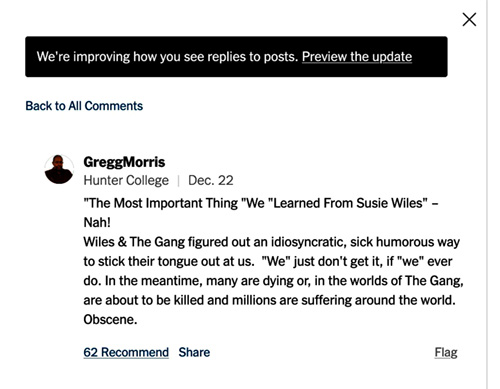
“The Most Important Thing “We “Learned From Susie Wiles” – Nah! Wiles & The Gang figured out an idiosyncratic, sick humorous way to stick their tongue out at us. “We” just don’t get it, if “we” ever do. In the meantime, many are dying or, in the worlds of The Gang, are about to be killed and millions are suffering around the world. Obscene.


View this profile on Instagram


Waging Nonviolence (@wagingnv) • Instagram photos and videos

the WORD Editor Gregg W. Morris

Leave a Reply

This site uses Akismet to reduce spam. Learn how your comment data is processed.

Film Preview Filmmaker Suzannah Herbert’s Award Winning Documentary NATCHEZ Opens January, 30 at Film Forum WINNER – Best Documentary, 2025 Tribeca Festival

Natchez, Mississippi: a town of 15,000 for generations has drawn tourists to its immaculately restored antebellum mansions, hosted by hoop-skirted white matriarchs, for an experience dubbed “Pilgrimage.” As interest declines in and questions arise about showcasing these regal estates with tall tales of the “Old South,” Natchez faces a reckoning—with a romanticized, sanitized historical narrative and the debt it owes to the descendants of enslaved people.
Directed by Suzannah Herbert—a documentary filmmaker whose work focuses on the American South—NATCHEZ follows owners of historic plantations, local activists and politicians, and both white and African American tour guides as they tell their ever-more conflicting versions of the town’s past, and of American history.

NATCHEZ had its world premiere at the 2025 Tribeca Festival where it was awarded the prize for Best Documentary and Special Jury Awards for cinematography (Noah Collier) and editing (Pablo Proenza). It was also featured at Charlotte Film Festival (Winner: Documentary Feature Audience Award), Philadelphia Film Festival (Winner: Best Documentary Feature), and more. NATCHEZ was named one of the Top 5 Documentaries of the Year by the National Board of Review and was awarded for Best Editing at the International Documentary Association IDA Awards.

Executive Producer Sam Pollard has been called one of “cinema’s most dedicated chroniclers of the Black experience in America.” He has collaborated with Spike Lee since 1990, editing and co-producing a number of Lee’s films. Pollard has directed and produced SLAVERY BY ANOTHER NAME (PBS), AUGUST WILSON: THE GROUND ON WHICH I STAND (American Masters), TWO TRAINS RUNNIN ’(American Masters), and more. His 2020 film MLK/FBI (IFC Films) was shortlisted for an Academy Award for Best Documentary Feature.

Darcy McKinnon is a documentary filmmaker whose work focuses on the American South and the Caribbean. Recently released projects include A KING LIKE ME and ROLEPLAY, premiering at SXSW 2024, COMMUTED (PBS, 2024), ALGIERS, AMERICA (Hulu, 2023), UNDER G-D (Sundance 2023), LOOK AT ME! XXXTENTACION (SXSW, Hulu, 2022) and THE NEUTRAL GROUND (Tribeca, POV, 2021), recipient of LEH Documentary of the Year 2022. Darcy is an alum of the Impact Partners Producing Fellowship and the Sundance Institute Creative Producing Fellowship, and a recipient of American Documentary’s Creative Visionary Award in 2023.

“Raises urgent questions…. The genteel politeness on display at the start of the film falls away, revealing an unsettling core. How can a city move forward without acknowledging the past? That’s not just a question for Natchez, but one for America as a whole.”
– Lovia Gyarke, The Hollywood Reporter

“A tough and complex depiction of intractable racism…Thanks to the discerning eyes of Herbert and cinematographer Noah Collier, we see hypocrisy leak from the faces of their subjects, exactly as it does from the faces of the actors in Jordan Peele’s GET OUT. But NATCHEZ is not a horror film. Rather, it depicts the contest between two versions of history, the stakes of which are the American present and its possible future.”
– Amy Taubin, Film Comment

“Captures the contradictions and tensions of a small Mississippi town reliant on Antebellum tourism with polyphonic complexity. Its implications broaden as its focus grows ever more specific, and in Herbert’s humanistic yet uncompromising direction, Natchez emerges as a microcosm of how the violent white supremacy embedded in the founding of the United States continues to infect the present. In her probing and critical, yet invariably empathetic, interrogation of this tension in the unsettled community of Natchez, Herbert has crafted a major achievement in documentary filmmaking.”
Robert Stinner, In Review Online

Directed and Produced by Suzannah Herbert. Produced by Darcy McKinnon. Executive Producers: Sam Pollard, Cindy Meehl, Carrie Lozano, Lois Vossen, Ted Haddock. Director of Photography: Noah Collier. Editor: Pablo Proenza. Music: James Newberry. Featuring Tracy “Rev” Collins, Tracy McCartney, David Garner, Deborah Cosey, Kathleen Bond, Barney Schoby, Mayor Dan Gibson, Ser Boxley. USA. An Oscilloscope Laboratories Releas

Presented with support from The Richard Brick, Geri Ashur, and Sara Bershtel Fund for Social Justice Documentaries and The Endowed Fund for Emerging Filmmakers.

the WORD Editor Gregg W. Morris

Leave a Reply

This site uses Akismet to reduce spam. Learn how your comment data is processed.

A PEN America Must-See


At this year’s Annual General Meeting, we gathered virtually to envision the future of PEN America, reflect on how we navigate this fraught political climate, and strengthen our commitment to defend the liberties of writers during this perilous time.

Special remarks were delivered by Jennifer Finney Boylan, President of PEN America’s Board of Trustees, alongside Clarisse Rosaz Shariyf, Interim Co-CEO and Chief Program Officer for Literary Programming, and Summer Lopez, Interim Co-CEO and Chief Program Officer for Free Expression. The vote for new offers and trustees of the board was followed by an insightful conversation with authors Rex Ogle, Padma Venkatraman, and Maggie Tokuda-Hall, and PEN America’s Freedom to Read Program Director, Kasey Meehan about authors, activism, and artistry.

There was no direct mention of Donald Trump at Annual Meeting itself, but in PEN America’s broader 2025 advocacy and press outside the meeting, the organization has publicly commented on and criticized aspects of the Trump administration’s policies.


the WORD Editor Gregg W. Morris


Leave a Reply

This site uses Akismet to reduce spam. Learn how your comment data is processed.