More than 20 years after legal scholar David C. Yamada introduced the first version of the Healthy Workplace Bill, no U.S. state has enacted the legislation in its original form — even as concerns about toxic workplaces, institutional intimidation, and employee mental health continue to grow nationwide.

Prof David Yamada. Pic from his Facebook page
The Healthy Workplace Bill, first introduced in California in 2003, was designed to give workers legal protections against severe workplace bullying and psychological abuse that fall outside traditional discrimination law. Versions of the proposal have since been introduced in 31 states and two U.S. territories.
Yamada, a professor at Suffolk University Law School in Boston, argued that American labor law leaves a major gap for workers subjected to repeated humiliation, intimidation, verbal abuse, sabotage, or other conduct that may be deeply harmful but not technically illegal unless tied to race, sex, religion, age, disability, or retaliation protections.
Advocates say that gap has become increasingly visible in recent years as public conversations about “toxic workplaces,” burnout, psychological safety, and institutional abuse have intensified across higher education, media organizations, corporations, hospitals, and government agencies.
“Workplace bullying” itself has become a far more mainstream term than it was when the legislation first appeared. Yet legislative progress has remained limited. Business organizations and employer groups have long opposed broad anti-bullying statutes, arguing they could generate excessive litigation and interfere with management authority.
In response, advocates associated with the Workplace Bullying Institute have begun promoting a revised framework known as the Workplace Bullying Accountability Act, which places greater emphasis on employer responsibilities, internal prevention policies, training requirements, and anti-retaliation protections.
Puerto Rico remains the closest U.S. jurisdiction to adopting legislation resembling the Healthy Workplace Bill model after approving a workplace harassment law in 2020 that addresses repeated abusive conduct in the workplace.
The continuing debate reflects a broader tension in American employment law: many forms of harsh or degrading workplace behavior may be widely viewed as unethical or psychologically damaging while still remaining legal under existing statutes.
That reality has become especially relevant during a period of heightened national polarization and growing public concern about institutional culture, employee treatment, and workplace power dynamics.
For supporters of workplace anti-bullying legislation, the central argument remains unchanged: dignity at work should not depend solely on whether abuse can be linked to a legally protected category.
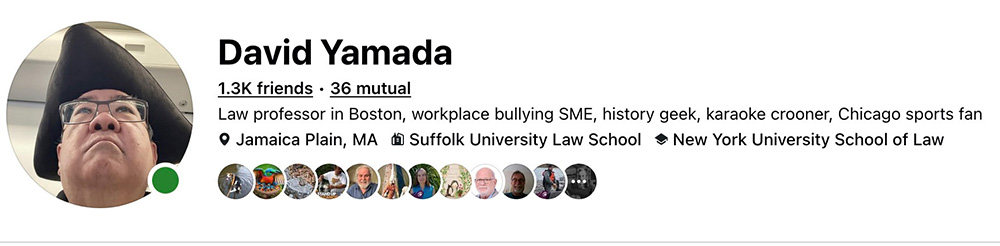
Prof David Yamada (from his Facebook page)
