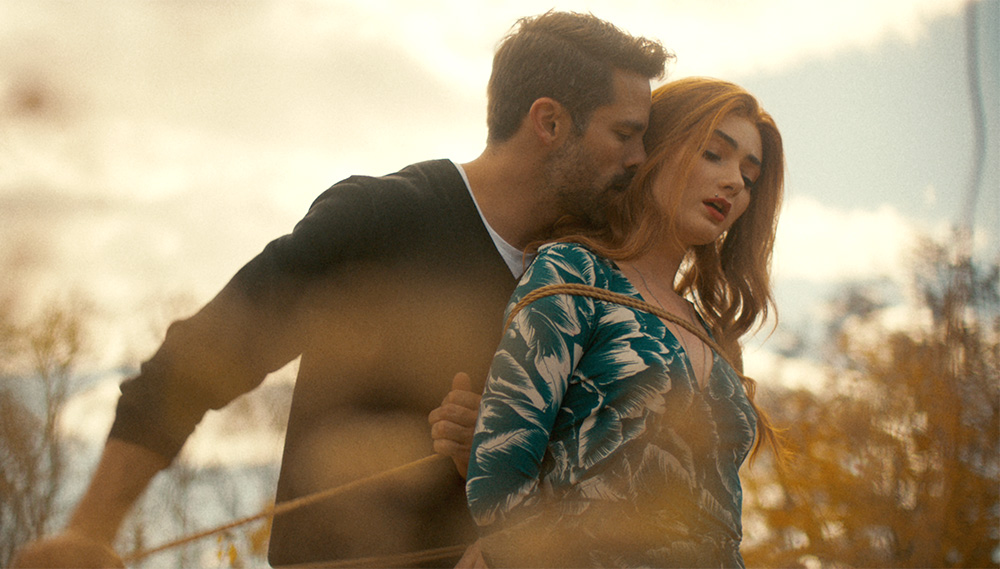
Aarresting erotica – one of many – from Director Madison Young’s BY THE ROOTS.
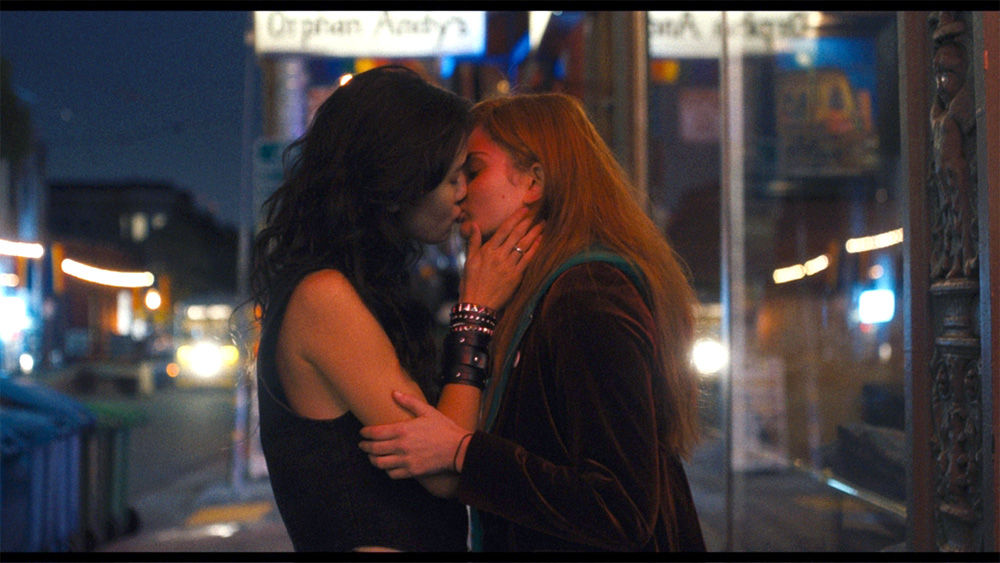
An arresting scene from Director Madison Young’s BY THE ROOTS.
Shibari (縛り), Japanese for “to bind” or “to tie,” is a modern, often artistic form of Japanese rope bondage used for eroticism, intimacy, and trust-building. Rooted in historical hojojutsu (samurai restraining techniques), it is now widely practiced as a consensual, aesthetic, and meditative art form focusing on intricate patterns and connection, frequently called kinbaku.
BDSM is an initialism for sexual practices involving Bondage & Discipline, Dominance & Submission, and Sadism & Masochism. It is a broad umbrella term for consensual, often high-intensity sexual activities centered on power dynamics, physical restraint, and sensory stimulation, rather than solely on pain or control.
In her feature directorial debut, Madison Young — a well respected, long-standing icon in the feminist adult film movement and a founder of San Francisco’s Femina Potens — delivers an unflinching, poetic masterpiece based on her 2014 memoir, Daddy.
Synopsis
BY THE ROOTS is an intensely personal indie drama blending memoir, identity politics, sexuality, trauma, and much more into a stunning cinematic statement adapted from Young’s memoir Daddy. BY THE ROOTS, her feature directorial debut, tells the tale of a successful queer, kinky gallerist in San Francisco in the early 2000s who is forced to confront buried pain and the multiple personality selves that shaped her adult life.
This is not conventional prestige filmmaking built around tidy plot mechanics – no way. Instead, BY THE ROOTS functions as emotional excavation. Honesty is Young’s strongest instinct as a filmmaker. She is more interested in truth, the whole truth and nothing but the truth more providing an audience comfort levels, thus giving the movie a raw pulse often missing from polished mainstream dramas.
Younger versions of Madison at different ages are in the movie, suggesting a layered structure in which childhood, adolescence, and adulthood exist simultaneously.
{Fragmentation of identity in movies refers to a character’s disjointed or non-unified sense of self, often caused by trauma, cultural conflict, or digital influence. It shows characters with multiple, conflicting personalities (e.g., Batman in The Batman) or represents psychological breakdown through fragmented narratives, flash-backs, and non-linear timelines (e.g., Memento)
Visually, one imagines the San Francisco setting as more than backdrop. For queer audiences especially, the city represents liberation, experimentation, chosen family, and reinvention. If Young successfully contrasts that outward freedom with inward unresolved wounds, the setting becomes dramatically meaningful rather than decorative.
Young’s long background as a filmmaker and advocate for ethical depictions of sexuality appears to inform the film’s treatment of intimacy. Coverage notes the involvement of intimacy coordinator Maya Herbsman, which suggests care in staging vulnerable scenes. That matters. Too many films confuse explicitness with depth. Here, sexuality likely functions as character language rather than provocation.
Where BY THE ROOTS may divide viewers is its pacing and structure. Memoir-driven films often risk becoming episodic or overly internal. Audiences seeking a straightforward narrative arc may find portions elliptical or emotionally dense. But viewers open to character studies and experiential storytelling are more likely to appreciate the filmmaker’s ambitions.
The performances — particularly whoever carries the adult Madison role — would be central to success. A film like this requires emotional transparency without self-pity, strength without hardening, vulnerability without collapse. If the cast meets that challenge, the film can resonate far beyond autobiographical specifics.
BY THE ROOTS is an intrepid and necessary work: Queer cinema rooted not in stereotype or market trend, but in live complexity. Memory, survival, embodiment, and the difficult labor of becoming whole resonate throughout the film. Audiences that value intimate, fearless independent filmmaking: BY THE ROOTS shouldn’t be missed.
A Few Additional Facts for Cinematic Enlightenment and Review Wrap Up
BY THE ROOTS is a 2025 autobiographical queer feminist film based on Madison Young’s memoir, Daddy. It follows a queer, kinky gallerist and sexual revolutionary (Emily Robinson) returning to conservative Ohio from San Francisco, forced to reconcile her present life with the painful past and family she left behind. Director Madison Young’s memoir, Daddy (2013), is a candid exploration of her search for a “heroic figure” in her life, mapping her journey from a strained relationship with her biological father to finding empowerment in BDSM “leather daddies” and sex work. The memoir highlights her dual life as an independent San Francisco artist/gallery owner and an active participant in sexual revelation.
Key Aspects of the Memoir: The book centers on a “Little Girl’s fantasy” searching for a protective, dominant paternal figure, examining how these relationships (both emotional and sexual) shaped her, notes theAmazon product page for the memoir. Sex Positive Narrative: Young, a prominent sex educator and filmmaker, presents an intimate look at the politics of BDSM and “leather daddies” in the San Francisco scene. The narrative explores the shattered fantasy of the perfect “Daddy” when confronted with the realities of human nature and flaw. Some readers found the style to be a collection of loosely related life events, while others lauded it for its raw emotional honesty and self-examination.
Daddy: A Memoir is framed not just as a sexual exploration, but as a deeper look into the “fraught relationship” with her paternal past.
Reviews for Madison Young’s Daddy (2013) were mixed, with many readers appreciating the raw, honest look into her life as a porn actress, sex educator, and art gallery owner, while others found the writing style less engaging. The memoir was often described as an intimate, “unfiltered” examination of her search for a “daddy” figure and personal identity.

the WORD Editor Gregg W. Morris